How to Hit 3-Wood Off the Tee on Tight Holes: The Tee-Height and Start-Line Plan That Finds More Fairways
A tight driving hole does not automatically mean bunt-swing panic. Use this 3-wood tee-shot plan, exact tee-height checkpoints, start-line rules, and three drills to keep more tee balls in play without giving away distance for no reason.


Tight tee shots make a lot of golfers do one of two stupid things:
- hit driver because they are offended by restraint
- or hit 3-wood with the same scared little bunt swing they use when they have already decided the shot is hard
Both are bad.
The point of 3-wood on a tight hole is not to make a defensive half-swing and pray.
The point is to hit a normal, committed tee shot with a club that fits the hole better.
If you already know the bigger pre-round planning picture matters, start with the fairway-finder tee-shot plan, how to pick the right tees, and how to save a round when driver is gone. This piece is the tighter follow-up for the specific shot a lot of golfers still butcher once they actually make the smart club choice.
The Job Is Not “Hit 3-Wood Softer”
The job is this:
- tee it at the right height
- pick a start line you can actually commit to
- make a balanced swing at roughly 90 percent
- and finish with the ball in the biggest useful part of the fairway
That is it.
You are not trying to manufacture some tiny steering move that “just keeps it in play.”
That version usually produces the wipey block, the heel cut, or the low runner that leaks into exactly the side you were trying to avoid.
When 3-Wood Off the Tee Actually Makes Sense
I want 3-wood to be the default tight-hole tee club when:
- the fairway pinches too much at driver carry
- the driver miss brings penalty trouble or immediate punch-out golf
- the hole bends enough that total driver distance is more nuisance than help
- or driver only saves 15 to 20 yards while multiplying the risk
That is the same adult math behind short par 4 strategy and the first-three-holes script. The longest club is not always the best scoring club.
Tee It Lower Than You Think
This is the first big fix.
A lot of golfers tee 3-wood too high because the clubhead looks vaguely driver-ish and their brain gets lazy.
My default 3-wood tee height:
- about one-quarter of the ball above the crown
- or, more simply, the ball should look barely helped, not perched
What I want visually:
- the bottom of the ball still looks close to the top line
- the club can sweep it cleanly
- and you do not feel like you have to swing up hard to find the middle
What happens when the ball is teed too high:
- golfers tilt back too much
- contact climbs too high on the face
- spin gets weird
- and the miss turns into that floating wipe that feels safe for half a second before it finds the trees
What happens when it is too low:
- you start trying to pick it too perfectly
- low-face contact shows up
- and the shot can come out weak and spinny
The right tee height should make the shot feel like a clean sweep, not a rescue operation.
Ball Position: Slightly Forward, Not Driver Forward
For 3-wood off the tee, I want the ball:
- one ball inside the lead heel
- not off the front toe
- and not shoved back to the middle because you got scared
That puts you in the right spot to:
- catch it cleanly
- sweep it from a shallow angle
- and still keep the strike centered enough to produce a boring flight
If you want the full fairway-wood contact picture, read how to hit fairway woods and hybrids off the deck. The tee-shot version is a little easier, but the same sweep-not-help logic still applies.
Use a 90 Percent Swing, Not a Careful Swing
This is the whole difference.
I do not want:
- a lash
- a bunt
- or a “just guide it out there” stroke
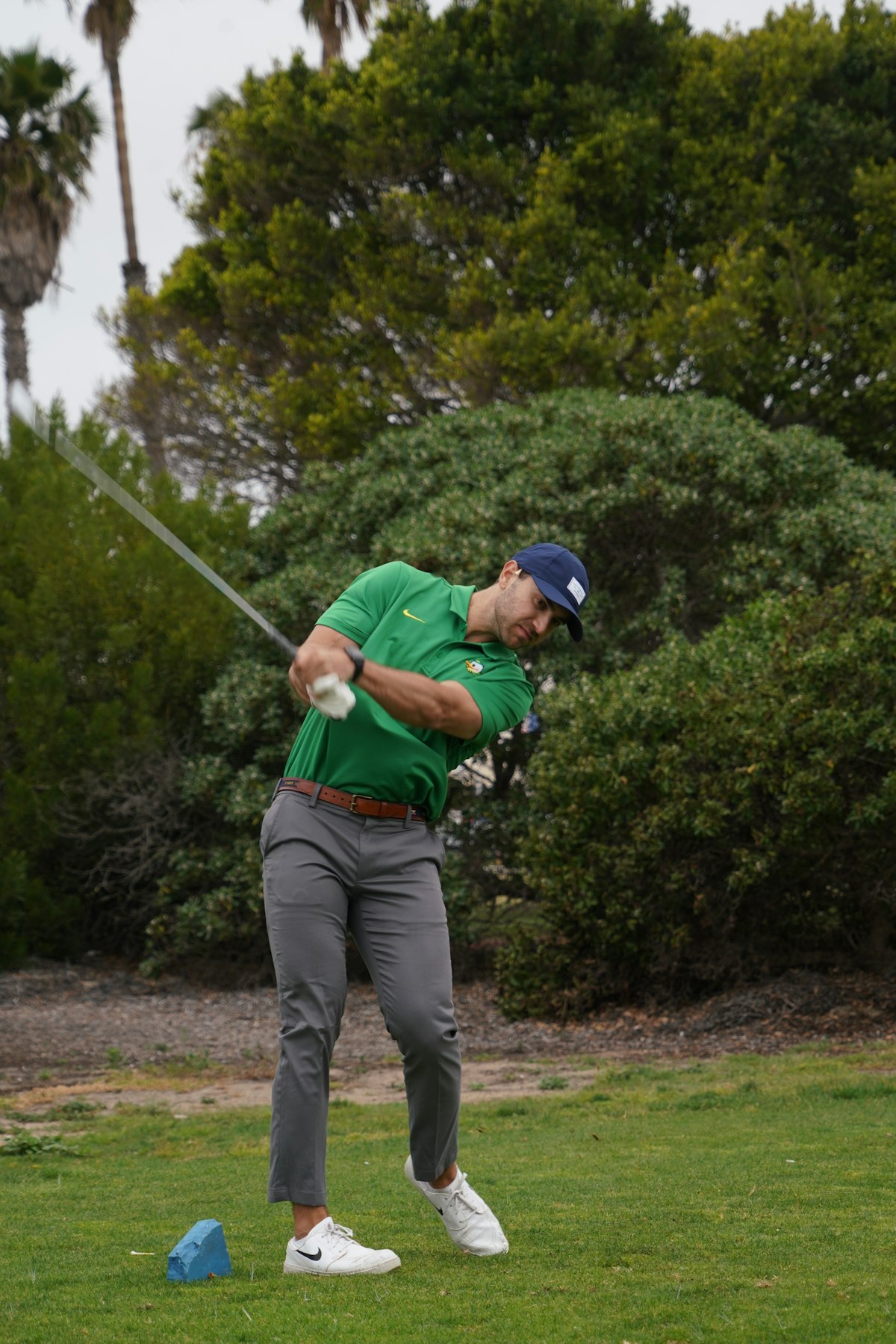
I want a 90 percent committed golf swing.
That means:
- normal rhythm
- full turn
- balanced finish
- and no sudden deceleration because the hole looks narrow
The 3-wood fairway-finder swing should feel:
- slightly shorter than all-out driver
- more centered
- and more controlled through the finish
If you start trying to steer it, you usually lose the exact thing you picked the club for:
predictability
Pick a Start Line, Not Just a Fairway
Most golfers aim 3-wood on tight holes like this:
“Somewhere over there that is hopefully not jail.”
That is useless.
I want a start line with an actual purpose.
Use this rule:
Aim your 3-wood at the widest playable half of the landing area, not at the center stripe by default.
Examples:
- trouble left, room right: start it at the left-center of the safe window and let the normal shot work
- trouble right, room left: start it at the right-center of the safe window
- both sides ugly: aim at the fattest section and accept that perfect is not the assignment
Your target should be specific enough that you could point to:
- a bunker edge
- a tree line gap
- a fairway shade change
- or a TV tower / clubhouse corner in the background
That is the same specific-target discipline from the two-tee putting gate drill and pre-shot commitment. Vague targets create vague swings.
What Good 3-Wood Contact Off the Tee Looks Like
On a good 3-wood tee ball, I want:
- a medium-high flight, not a moon ball
- center or just slightly high-face contact
- a finish that feels balanced, not held off in panic
- and a curve that is modest enough to live inside the hole shape
I do not want:
- a low heel bleeder
- a high weak wipe
- or a perfect one-off bomb that only encourages future bad decisions
This is a find-the-fairway shot, not a self-esteem contest.
The Two Biggest Mistakes on Tight-Hole 3-Wood
1. Swinging too carefully
This is the classic miss.
The golfer picks the right club, then ruins it by making the wrong motion.
Careful swings usually produce:
- open-face contact
- heel strikes
- and a shot that leaks into the exact side trouble you were trying to avoid
2. Using driver setup with 3-wood intentions
Too high a tee. Too much tilt. Ball too far forward.
Now you are basically trying to hit a small driver with a club that does not want that job.
That is how the fairway-finder club turns into a fairway-misser with extra confusion.
My Tight-Hole Decision Checkpoint
Before I pull 3-wood on a narrow hole, I want three answers:
- What number do I actually need to cover?
- What side miss can I live with?
- Does 3-wood remove the expensive miss better than driver does?
If the answer to No. 3 is yes, stop overthinking it.
Hit the club you already know makes the hole easier.
The 3 Tight-Hole Buckets
1. Tight but straightforward
This is the classic fairway-finder hole:
- trees or bunkers narrow the landing zone
- but the hole shape itself is simple
Plan:
- 3-wood
- quarter-ball tee height
- 90 percent swing
- start line at the fattest safe half
2. Tight with one dead side
Now the target matters more.
Plan:
- aim away from the disaster, not at the stripe
- favor the safe miss
- and accept that center-cut is optional
This is where golfers get greedy and bring the dead side back into play with a “trust it” speech that should have stayed internal.
3. Tight and short enough that 3-wood is still too much
This is the sneaky trap.
Just because you are scared to hit driver does not mean 3-wood is automatically correct.
If 3-wood still runs through the fairway or brings the same trouble in:
- hit hybrid
- hit driving iron
- hit whatever keeps the ball in front of you
That is grown-up golf, not coward golf.
Drill 1: The Quarter-Ball Tee Ladder
At the range, hit 12 balls with 3-wood:
- 4 balls teed just a hair too low
- 4 balls at your quarter-ball ideal
- 4 balls a little too high
Track:
- start line
- flight height
- strike quality
You are looking for the tee height that gives you:
- the most centered contact
- the most boring flight
- and the fewest wipey misses
For most golfers, that middle quarter-ball height wins fast.
Drill 2: The 25-Yard Gate
Create a fairway gate on the range roughly 25 yards wide.
Hit 10 tee balls with 3-wood.
Scoring:
- 2 points: through the gate
- 1 point: barely outside but still clearly playable
- 0 points: obvious trouble ball
Benchmarks:
- 16 or better out of 20 means the club is trustworthy
- 12 to 15 means usable but still loose
- 11 or worse means your fairway finder is more theoretical than real
Drill 3: The Driver-or-3-Wood Test
This is the truth serum.
Hit:
- 5 drivers
- 5 three-woods
All to the same narrow target window.
Then write down:
- how many stayed inside the gate
- which club produced the worse miss
- and whether the distance gap was actually meaningful
If your driver goes 18 yards farther but doubles the disaster rate, that is not a weapon on a tight hole.
That is just louder trouble.
On-Course Checkpoints That Actually Matter
For your next five rounds, track every time you hit 3-wood off the tee and write down:
- hole type
- tee height
- start line
- result
What counts as success:
- ball in fairway
- or in first-cut rough with a clean next shot
What counts as failure:
- penalty
- punch-out
- blocked angle that forces a layup
The goal is not perfection.
The goal is proving that your “tight-hole club” actually lowers the blast radius.
What I Want You Thinking on the Tee
Not:
- do not miss right
- do not bail out
- do not screw this up
I want:
- low tee
- specific start line
- normal 90 percent swing
That is enough.
The hole is already hard enough. Do not add amateur theater on top of it.
Bottom Line
The best 3-wood tee shot on a tight hole is not a bunt.
It is:
- the right quarter-ball tee height
- a ball position one ball inside the lead heel
- a specific start line into the fattest safe window
- and a 90 percent committed swing
Do that, and 3-wood stops being the club you grab when you are scared and starts being the club you grab when you are smart.
That is a much better reason.
If you want the larger tee-shot package, pair this with the fairway-finder tee-shot plan, how to save a round when driver is gone, and how to play short par 4s without dumb bogeys. Those three pieces plus this one cover a stupid amount of scorecard damage.
Image: Unsplash
Related Articles