Erin Hills First-Timer Guide: Walking Reality, Caddie Math, and the No-Hero Script
Planning Erin Hills for the first time gets much easier when you know the walking-only rules, real round length, caddie costs, tee-yardage bands, and the simple strategy checkpoints that keep the place from becoming a five-hour ego tax.

There is a very specific way to waste an Erin Hills round.
You show up to one of the biggest walking tests in public golf, get seduced by all the width, tell yourself the place is more generous than the U.S. Open reputation suggests, and then spend nearly five hours discovering that wide is not the same thing as easy.
That is the dumb version.
This is not a fake firsthand diary where I pretend I just came off property with secret wind notes and a spiritual attachment to every rumple. This is a practical first-timer guide built from Erin Hills’ current official course, rates, FAQs, caddie, and scorecard pages checked on Friday, August 7, 2026.
If you want the bigger worth-it verdict first, start with our Erin Hills review and best golf courses in Wisconsin. This page is for the golfer who already knows Erin Hills is on the trip sheet and wants the cleanest plan for not turning the day into long-walk cleanup.
Quick Answer
For most first-timers, the smart Erin Hills plan is:
- treat it like a full walking day, not a casual premium tee time
- assume the round is going to take close to five hours
- either budget for a caddie or be honest about what you lose by skipping one
- play from a tee that keeps you in the 6,252- to 6,537-yard neighborhood unless you have real carry speed
- and spend the whole day avoiding the high-side, short-sided, fake-aggressive miss
That is the adult version.
First Thing: This Is a Walking Day, Not a Cart Day
Erin Hills’ current FAQ is very direct:
- Erin Hills is walking only
- outside caddies and pull-carts are not allowed
- and the course asks you to plan on a four hour and fifty-five minute round
That matters more than the marketing poetry.
This is not the place to show up under-trained, under-hydrated, and weirdly confident that “I walk plenty” because you once strolled nine holes at your home course with a push cart and a transfusion.
Erin Hills is a real property. Treat it like one.
If your shoes are questionable, fix that before the trip with best golf shoes for walking 2026 and best golf shoes 2026.
Second Thing: No Twilight Means the Whole Day Is the Point
Erin Hills’ FAQ says the course does not offer twilight tee times because management wants guests to experience the entire golf course.
That is actually useful trip-planning information.
It means this round is supposed to be the event, not the late-afternoon add-on you wedge between breakfast bravado and dinner reservations.
Build your day around it.
What that means in practice
- eat before you start
- warm up properly
- carry more water than you think you need
- and do not book yourself into dumb post-round time pressure
The course already has enough ways to make you feel rushed. You do not need to bring your own.
The Caddie Math Is Real, but So Is the Value
Erin Hills’ current rates page lists:
- $65 per player caddie service fee
- $75+ recommended gratuity per player
- $65 per group forecaddie fee
- $35+ suggested gratuity per player for a forecaddie
That is real money.
It is also one of the easiest premium-golf charges to justify if this is your first time around a giant walking property with firm turf, massive greens, and a bunch of recovery shots that get expensive when you start guessing.
My first-timer advice:
- take a full caddie if this is your one-shot Erin Hills trip
- take a forecaddie if the group wants help without paying for the full deluxe version
- carry your own bag only if long walking rounds are already normal for you and you are not pretending
Erin Hills also rents the current TaylorMade setup for $85 per round, so if you are flying in and do not want baggage nonsense, that is at least a clean, current number.
Tee Choice: Be Honest Before the Course Does It for You
Erin Hills’ current scorecard lists these total yardages:
- Blue: 7,357
- Green/White combo: 6,537
- White: 6,252
- White/Gold combo: 5,670
The macho mistake is obvious.
You see the width, remember the place hosted a U.S. Open, and convince yourself you should “get the full experience” from farther back.
That is how you buy a lot of long-iron stress on a course that is already asking enough.
My practical first-timer rule:
- if your normal drive is more like 225 to 240, start at White
- if you are a stronger player with enough carry to still keep approaches sane, Green/White is the sharper first-visit test
- if you need Blue to feel validated, be honest about whether you are chasing golf or cosplay
That tee advice is my inference from the current scorecard and the shape of the course, not a direct Erin Hills instruction. It is still the smarter play for most people.
The Smart Way to Think About the Green Fee
Erin Hills’ current 2026 rates page says:
- $495 from May 26 through September 27
- $395 from May 4 through May 25 and September 28 through October 17
- $295 for an 18-hole replay, booked the same day and based on availability
If you are staying overnight during those shoulder windows, Erin Hills also lists a $200 second-round fee for stay-and-play guests.
That changes the trip math a lot.
There is also the Kettle Loop wrinkle. Erin Hills says there is no caddie or green fee for the Kettle Loop because it is reserved for overnight guests, by request and pending availability.
So the cleanest first-timer version is not “fly in, walk 18, and sprint home.”
The cleaner version is:
- book the shoulder-season window if you can
- stay on property if the budget allows
- and use the second-round / Kettle Loop access to spread the travel pain over more golf
Logistics That Actually Matter
Erin Hills’ FAQ says the property is:
- 35 minutes northwest of downtown Milwaukee
- 50 minutes from Milwaukee airport
- 80 minutes southwest of Kohler
- 130 miles from Sand Valley
That makes Erin Hills easier to pair than some golfers assume.
If you are building a Wisconsin route, it can work as:
- the championship anchor next to Whistling Straits
- the big-splurge contrast to Lawsonia Links
- or the serious-golf day inside a broader Wisconsin trip built from best golf courses in Wisconsin
Erin Hills also says the dining room opens at 6:00 a.m., which is useful because a walking round that long goes a lot better when breakfast is not an afterthought.
The No-Hero Script for the Round
This is the sentence I would write on the card:
At Erin Hills, your bad miss cannot also be proud.
The width invites you to feel bold. The greens punish you for being dumb from the wrong side.
So the whole day is about discipline.
1. Through six holes, your goal is no doubles
That is it.
Not “I need to attack while I am fresh.” Not “I can take advantage before the wind gets up.”
Just:
- keep the ball in front of you
- keep penalties off the card
- and let the course show you how far the ball is really releasing
If you are +3 or better through 6 with no doubles, you are doing fine.
2. Play to the fat side and make the putter work
Erin Hills’ course page talks about firm playing surfaces and a layout that can play shorter than the raw scorecard because of the ground.
That is fun off the tee. It is less fun when you short-side yourself on or around those greens.
This is the exact kind of place where how to play firm greens without short-siding yourself stops sounding like generic advice and starts saving real shots.
3. On long par 4s, stop trying to force “proper” golf
If you are outside your comfort window, play for the easiest bogey on the property.
That usually means:
- front-edge or center-green target
- no miracle carry decision
- and no emotional extra club just because the hole looks big and expensive
If you need that mindset reset, read how to play long par 4s without making doubles and how to save a round when driver is gone.
4. On par 5s, lay up to a number you actually own
I would much rather have:
- 95 to 110 yards
- or 115 to 130 yards
…than some brave garbage from a half-fit lie on a first visit.
If that decision tree needs work, go back through when to go for par 5s in two.
The One Practice Block I Would Do Before the Trip
If you only get one prep session before Erin Hills, make it this:
The 9-ball lag ladder
Hit:
- 3 putts from 30 feet
- 3 putts from 40 feet
- 3 putts from 50 feet
Rules:
- every ball has to finish inside 3 feet
- if more than 2 of 9 finish outside that circle, start over
Why this drill?
Because a first Erin Hills round gets a lot less scary when your first putt is allowed to be boring.
Bottom Line
For a first-timer, Erin Hills is not mainly a courage test. It is a planning test.
The current official pages checked on Friday, August 7, 2026 make the shape of the day pretty clear:
- it is walking only
- it is basically a five-hour round
- it does not do twilight
- the caddie math is real
- and the scorecard gives you a clean adult lane at White (6,252) or Green/White (6,537) if you are honest
Pick the right tee. Budget the walking. Stop trying to win the trip on every long approach.
Do that, and Erin Hills looks like the kind of first round you remember for the golf instead of for the cleanup.
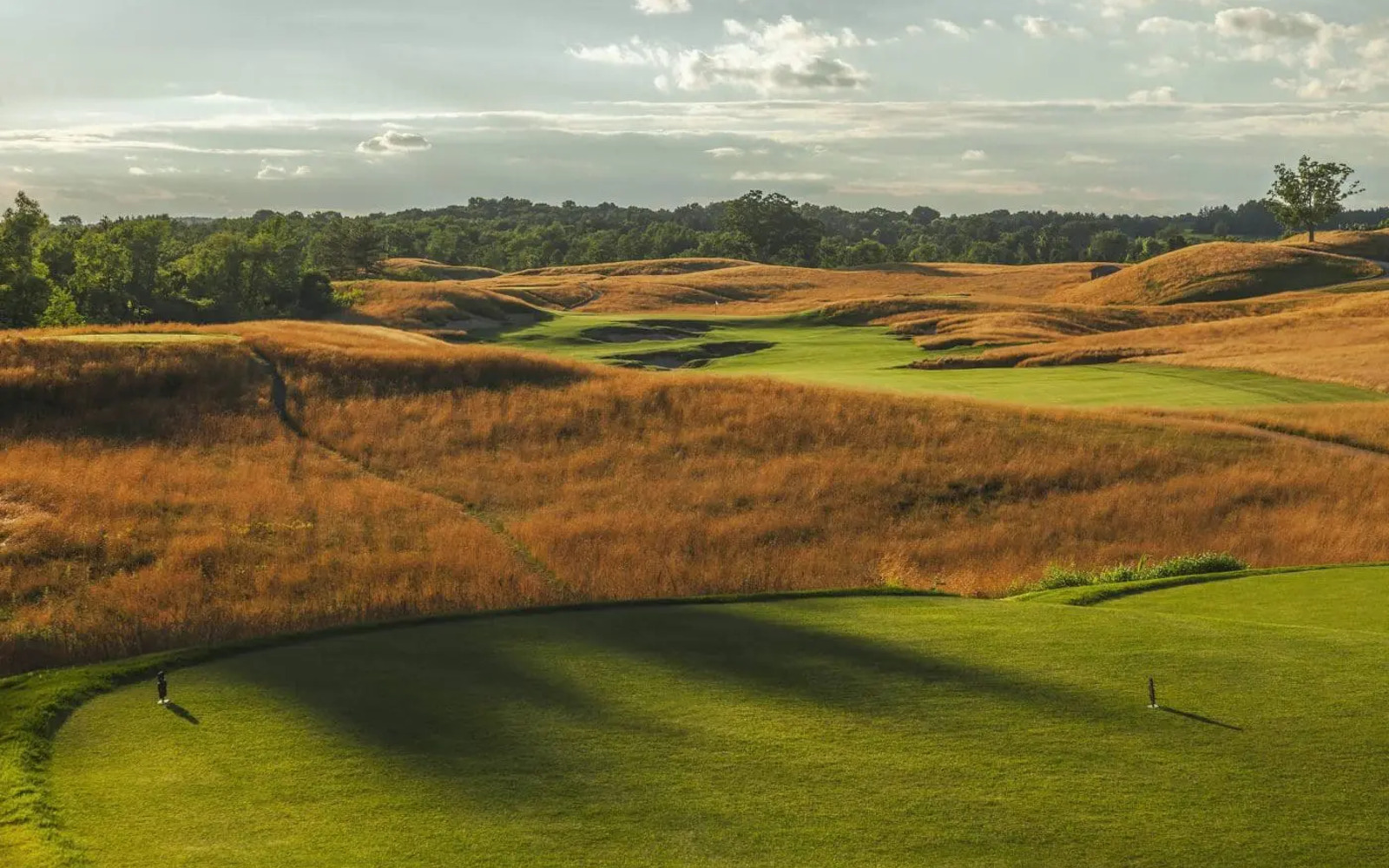
Image: Erin Hills
Related Articles