Whistling Straits First-Timer Guide: Walking Math, Tee Honesty, and the No-Hero Script
A practical Whistling Straits first-timer guide built from current August 16, 2026 Kohler policies, Straits scorecard details, and hole notes so you can handle the walking, caddie spend, and shot choices without turning the day into expensive chaos.

There is a very specific way to light money on fire at Whistling Straits.
You book one of the loudest public rounds in America, show up under-trained for a walking-only day, pick a tee box that flatters your ego more than your carry numbers, and then spend five hours pretending the lake, wind, and bunkers are the only reason the card got weird.
That is the dumb version.
This is not a fake firsthand diary where I pretend I just came off the Straits with secret lake-breeze wisdom and a spiritual connection to every pot bunker. This is a practical first-timer guide built from Kohler’s current 2026 golf policies, current Straits Course scorecard, current hole-by-hole guide, current package details, and current getting-there information checked on Sunday, August 16, 2026.
If you want the bigger worth-it verdict first, start with our Whistling Straits review and best golf courses in Wisconsin. This page is for the golfer who already knows the Straits is on the trip board and wants the cleanest plan for surviving the day like an adult.
Quick Answer
For most first-timers, the smart Whistling Straits plan is:
- treat it like a full walking day, not a scenic resort loop
- budget for a caddie unless you are weirdly comfortable reading a huge Pete Dye course in the wind by yourself
- play from White (6,360) or Green (6,663) unless you have real speed and long-iron control
- use the public twilight, super twilight, and replay discounts only if you accept the tradeoff that your first look may feel more rushed
- and spend the whole day aiming for the safe section of the hole instead of chasing the postcard line
That is the whole script.
First Thing: This Is a Walking Round, Not a Cart Round
Kohler’s current 2026 golf policies are very direct:
- The Straits Course is walking only
- golf carts are not allowed
- caddies are highly recommended but not required
That matters because a lot of golfers keep treating Whistling Straits like the visual experience is the hard part.
It is not.
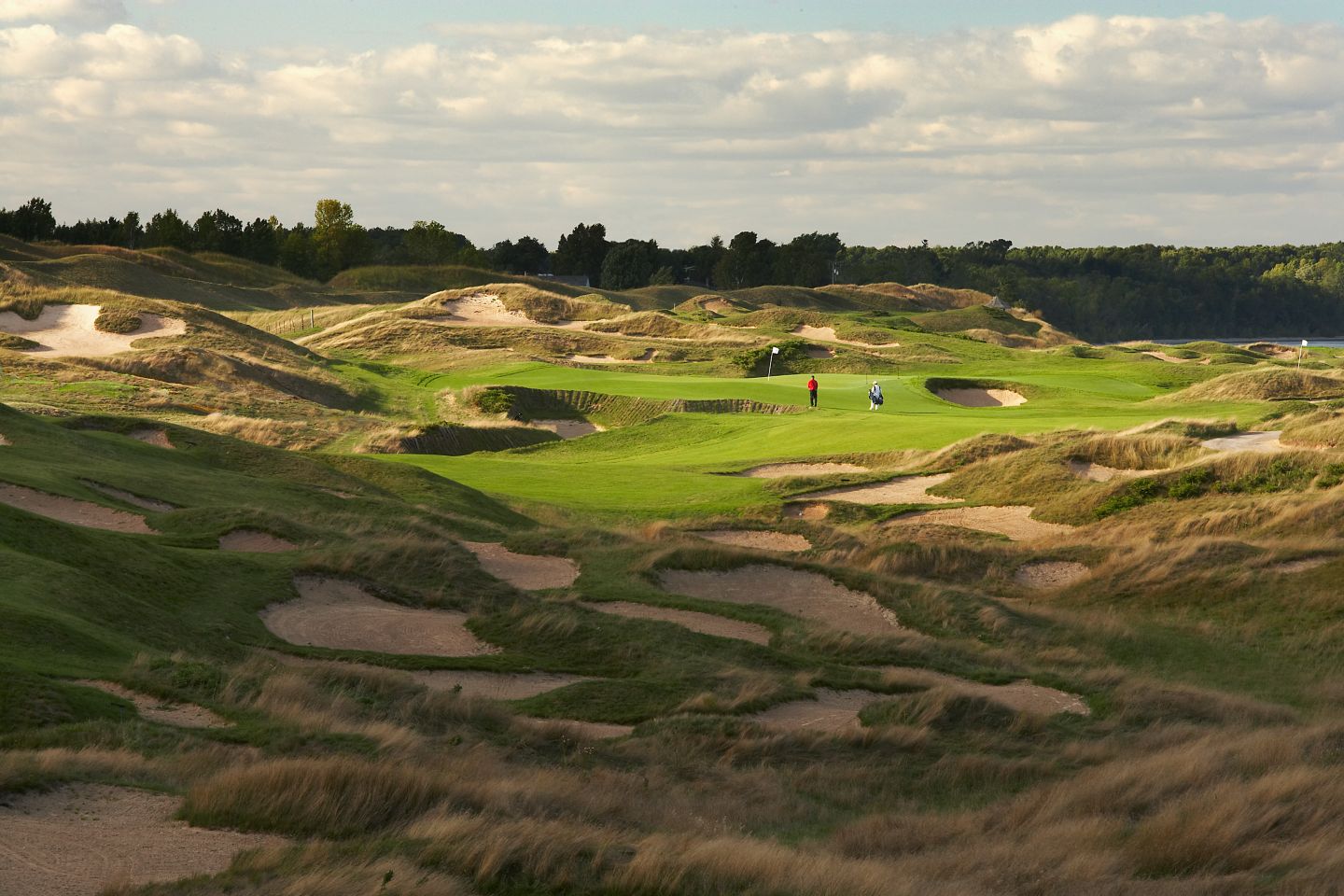
The hard part is making decent decisions while walking a big, exposed championship property that keeps changing shape when the wind shifts.
The same policies page also says golfers should use a single-strap carry bag under 24 pounds, and Kohler may require a change-out bag if yours does not fit the setup.
So no, this is not the day to show up with:
- a giant cart bag full of backup nonsense
- shoes you already know are optimistic
- or the plan of “I’ll just gut it out”
If your walking setup is shaky, fix that before the trip with best golf shoes for walking 2026 and best golf shoes 2026.
The Caddie Math Is Real, but So Is the Value
Kohler’s current policies list:
- $90 per person caddie fee on the Straits Course
- $70 per bag recommended gratuity
- $100 per person for rental clubs
That is real money.
It is also one of the easier premium-golf charges to defend if this is your first trip around a course with:
- major elevation shifts near greens
- wind that can change the club and the start line
- and a routing full of holes where the visually obvious line is not always the smart one
My first-timer advice is simple:
- take a walking caddie if this is your one-shot Straits round
- skip the hero carry-bag fantasy unless long walking rounds are already normal for you
- and if you are flying in, accept that $100 rental-club fee is cleaner than dragging a heavy travel setup just to prove a point
The current Kohler package page for To Dye Four also says bag carry fees are included on the Straits when you book that stay-and-play route, though caddie gratuity is still separate. If you are building a fuller Kohler trip, that is useful math.
Tee Choice: Be Honest Before the Lake Does It for You
Kohler’s current Straits scorecard lists:
- Black: 7,790
- Blue: 7,142
- Green: 6,663
- White: 6,360
- Red: 5,126
The mistake first-timers make is assuming the visuals justify moving back.
They do not.
Whistling Straits already asks enough from the round. You do not need to add a forced march of long-iron recoveries because the card looked more serious from the Blue markers.
My practical first-timer rule:
- if your normal drive is about 225 to 240, play White
- if you are more like 245 to 260 and still control mid-irons well enough, Green is the sharper first visit
- if you need Blue to feel validated, be honest about whether you are chasing golf or costume design
That tee advice is my inference from the current scorecard and the way the course is presented, not a direct Kohler instruction. It is still the smarter first-trip play for most people.
The Public Price Info Is Useful, Just Not in the Cute Rack-Rate Way
Kohler’s public policies page does not post a simple Straits rack number on the page itself. It pushes you to book online or call for individual tee times.
Annoying? A little.
Still useful? Yes, because the same page does publish the real discount levers:
- Twilight is 30% off rack rate starting 4.5 hours before official sunset
- Super twilight is 45% off rack rate starting 2.5 hours before official sunset
- Replay is 45% off rack rate after one same-day 18-hole round, based on walk-on availability
My first-timer take:
- twilight makes sense only if you mainly want to say you touched the Straits and accept a little pace pressure
- super twilight is better for repeat visitors or chaos-loving lunatics, not the clean first look
- replay is awesome value only if your body, weather, and group energy still make sense after the first walk
Kohler’s policies also note that walking caddies during Straits twilight times must be reserved in advance. That matters if you were planning to wing it.
Getting There Is Easier Than Some Bucket-List Trips
Kohler’s Whistling Straits location details currently list the course in Sheboygan, Wisconsin, roughly:
- 58 miles from Austin Straubel International Airport (GRB) in Green Bay
- 72 miles from General Mitchell International Airport (MKE) in Milwaukee
- 142 miles from O’Hare (ORD) in Chicago
That is one reason the trip works better than some golfers assume.
You can build it as:
- a one-big-day Kohler splurge
- a multi-round Kohler trip with Blackwolf Run
- or the luxury side of a broader Wisconsin route with Erin Hills, Lawsonia Links, or Sand Valley
If your real planning fork is Kohler versus Sand Valley, go straight to Sand Valley vs Kohler. That is the faster answer.
The No-Hero Script for the Round
This is the sentence I would write on the card:
Whistling Straits punishes ambition more than timidity when ambition is based on vibes instead of numbers.
That means the whole first-timer day should be built around restraint.
1. Through the first five holes, learn the wind before you challenge it
Kohler’s hole guide frames:
- No. 1 as a gentle dogleg left that starts the journey out toward the lake
- No. 4 as the hardest par 4 on the course
- No. 5 as a winding par 5 that demands accuracy tee to green
That is enough information to tell you the smart opening move:
- keep the ball in front of you
- use your stock shot shape
- and do not interpret “bucket-list round” as “attack immediately”
If you are through five holes with no doubles, you are doing fine.
2. Respect the greens before you respect the pin
Kohler’s hole guide says:
- No. 8 has a green that drops into a deadly back pot bunker
- No. 10 asks you to carry a deep valley and then hit an elevated green
- No. 12 has the most difficult green to manage with the putter
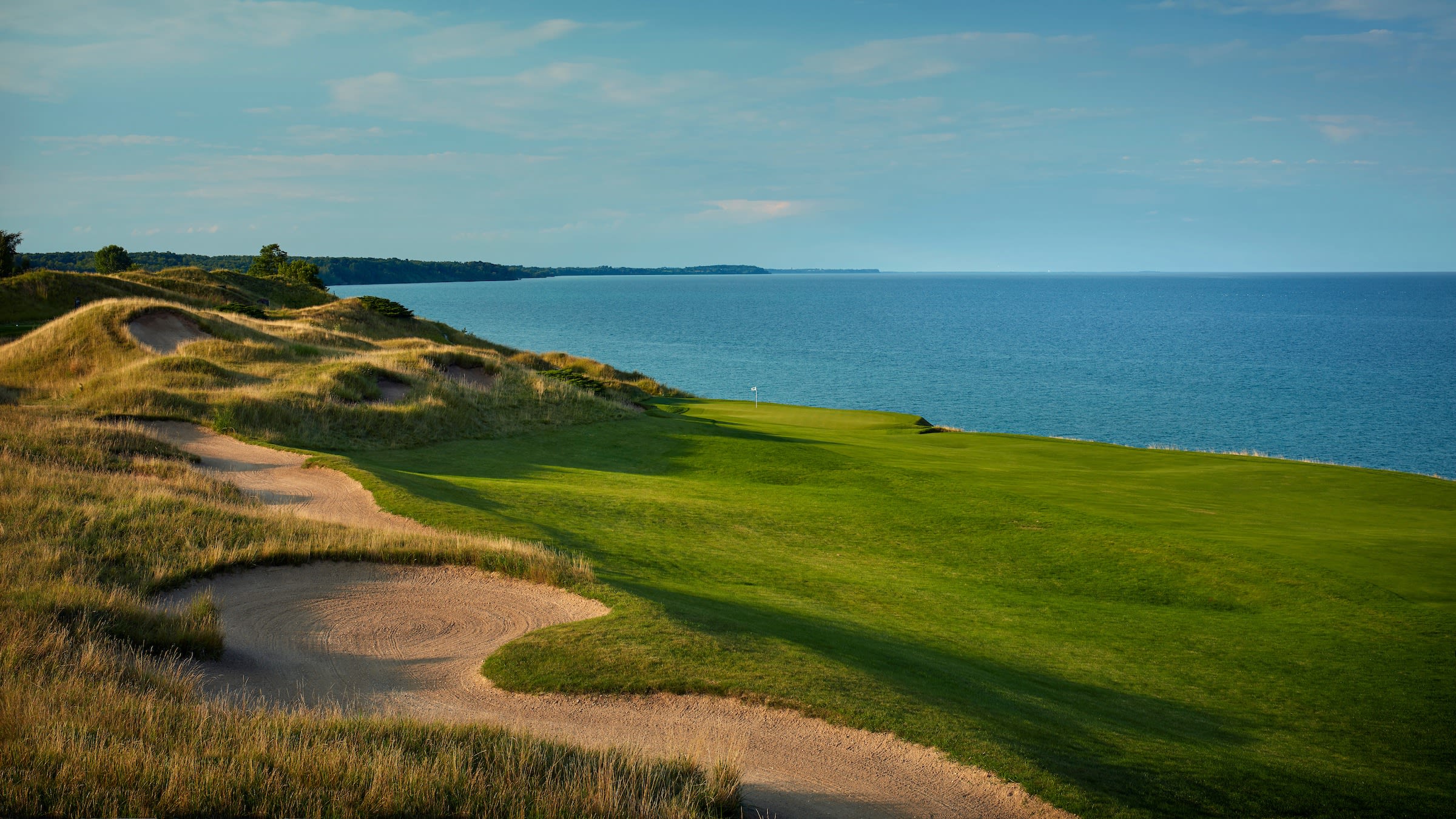
- No. 14 sits right on the cliff edge of Lake Michigan
That is not a list of “go make birdies” holes.
That is a list of holes where the correct first question is:
Where does a decent miss stay playable?
Before the trip, brush up with how to play front pins without making bogey, how to play back pins better, how to play firm greens without short-siding yourself, and how to play false front greens without coming back off them. The Straits is not the place to improvise your approach strategy in public.
3. On the par 3s, take enough club to cover the real miss
The current hole guide makes the par 3 personality pretty clear:
- No. 3 has a huge green but enough movement to make lag putting matter
- No. 7 is dramatic and shoreline-heavy
- No. 12 is short but awkward on the green
- No. 17 is neck-tightening for a reason
My first-timer rule on Straits par 3s:
- cover the safe surface first
- leave the ball below the hole if you can
- and stop pretending every scenic one-shotter deserves a flag chase
If you fight wind math already, read how to play crosswinds without overcorrecting and how to play downwind approach shots without flying the green.
4. The finish is not where you force a heroic memory
Kohler’s hole guide says No. 16 begins a four-hole stretch that could be considered among the most difficult in championship golf, and No. 18 is a finishing par 4 where par is very much “to be desired.”
That is your warning label.
If you get to the last three or four holes thinking you need one heroic swing to justify the green fee, you are about to build the exact kind of finishing-hole memory you will hate on the drive home.
The adult move is:
- keep the ball in the fat part of the fairway
- favor the safer side of the green
- and accept that strong first-trip golf at Whistling is mostly about not volunteering doubles
The One Practice Block I Would Do Before the Trip
If you only get one prep session before Whistling Straits, make it this:
The 12-ball wind-and-depth ladder
Hit:
- 4 balls with a mid-iron to a front-middle target
- 4 balls with a short iron to a middle target
- 4 balls with a wedge to a back-middle target
Rules:
- every shot must finish on the safe section, not just vaguely near the flag
- any shot that misses on the short-sided half is an automatic zero
- hold the finish for a 2-count after each swing
Goal:
- 8 of 12 safe finishes means your discipline is usable
- 10 of 12 means you are probably ready to trust boring targets
That is the skill the Straits wants more than anything else.
Bottom Line
For a first-timer, Whistling Straits is not mainly a courage test. It is a planning test.
The clean version is:
- walk it seriously
- pay for information if the budget allows
- pick the honest tee
- use the public discount windows only when they fit the actual goal
- and aim for the part of the hole that still leaves you playing golf
Do that, and the Straits stops feeling like expensive survival theater and starts feeling like what you actually paid for:
one of the best oversized public-golf days in America.
Image: Destination Kohler
Related Articles