Scottie Scheffler's Free Drop at Birkdale Was Legal, and That Is Exactly Why the TIO Rule Needs Work
AP's July 19, 2026 close-call report plus current R&A TIO guidance and Open local rules checked July 22 show Scottie Scheffler's relief at Royal Birkdale was allowed, which is exactly why the rule now feels too generous.
Image: The Open / R&A
If your reaction to Scottie Scheffler’s free drop at Royal Birkdale was, “That can’t possibly be legal,” I get it.
It looked absurd.
The annoying part is that it also appears to have been correct.
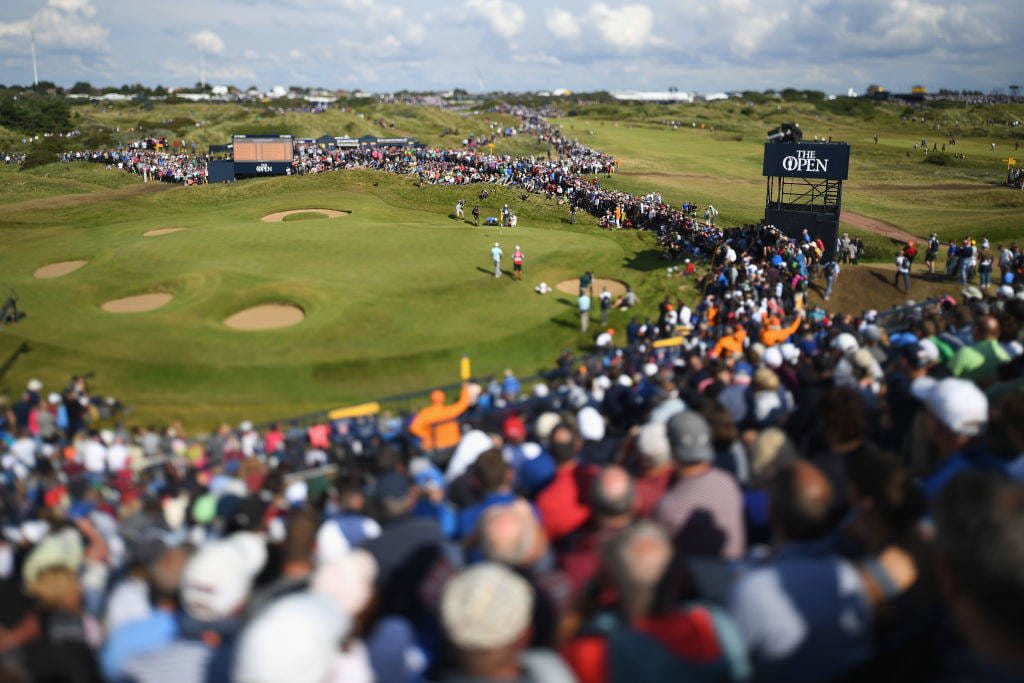
According to Associated Press reporting published Sunday, July 19, 2026, a same-day PGA TOUR recap, and The R&A’s current Model Local Rule F-23 guidance, TIO booklet, championship hard card, and additional local rules, all checked on Wednesday, July 22, 2026, Scheffler got relief on the 17th hole after hitting his approach over a tented hospitality area, because those structures are treated as temporary immovable obstructions, and Open-week local rules specifically state that all TIOs have an either-side relief option.
So no, this is not really a “Scheffler got away with cheating” story.
It is worse than that.
It is a story about a rule doing exactly what it is written to do and still making a huge chunk of the audience feel like the sport just rewarded a miss that had no business getting a soft landing.
This column is based on AP’s July 19 close-call report, the PGA TOUR’s same-day storylines recap, and The R&A’s current TIO guidance and local rules, all checked on July 22. No pretending I was out by the hospitality village helping draw the drop area in real time.
For the broader Birkdale context first, read our winner recap on Ryan Fox birdieing the 18th to win, our opinion on why Royal Birkdale did not need to apologize for low scoring, and our companion column on why Fox’s late-bloomer major win is exactly the kind of result golf needs.
The Ruling Looks Weird Because the Miss Was Weird
The easiest mistake here is blaming the wrong thing.
People saw a world No. 1 hit one way off-line, lose the ball near a tent, then still get a chance to make birdie on a hole where he desperately needed one to stay alive.
Of course that felt ridiculous.
AP’s July 19 reporting described it as a huge break in the middle of a close call, and the PGA TOUR recap said the ball went over a tented area short and left of the 17th green before Scheffler was granted TIO relief.
That visual is why the ruling turned into a debate so fast.
It did not look like golf justice. It looked like infrastructure insurance.
The Rulebook Side Is Pretty Clear
The problem for the outrage crowd is that the rules side is not especially murky.
The R&A’s Model Local Rule F-23 defines a temporary immovable obstruction as a structure temporarily placed on or next to the course for a competition. The current guidance explicitly lists examples like:
- tents
- scoreboards
- grandstands
- television towers
- toilets
The R&A’s TIO booklet says relief is normally allowed when there is physical or line-of-sight interference from a TIO. The R&A championships hard card says Model Local Rule F-23 is in effect at its championships. And the current additional local rules say that for these events:
- adjoining TIOs are treated as one TIO
- all TIOs have an either-side relief option
- that either-side option applies to line-of-sight relief
That is a lot of official language all pointing in the same direction.
The R&A’s own Schauffele ruling explainer from The 150th Open also makes the governing body’s philosophy pretty plain: grandstands, tents, and similar structures are not supposed to be part of the challenge of the hole, so free relief exists for them.
So if you are asking whether Scheffler got a made-up superstar exception, the answer looks like no.
He got the rule.
That Does Not Mean the Rule Feels Smart
This is where golf people always get themselves tangled up.
A ruling can be correct and still expose a bad design choice.
That is what happened here.
The current TIO framework makes sense when the goal is safety, logistics, and fairness around temporary championship furniture that players should not have to hit through.
But it starts feeling flimsy when a player launches a ball miles off the intended line, into or over a hospitality compound, and still ends up with a free reset good enough to keep the tournament alive for another few minutes.
At that point, the audience is not seeing a clean piece of rules administration. They are seeing the course’s most expensive real estate functioning like a bailout zone.
That is a problem.
The R&A’s Own Logic Is Also What Makes This Hard to Swallow
The R&A says TIOs are not part of the challenge of the hole.
Fine.
But when a player misses so far from the intended challenge that he is effectively in the tournament village, the more natural reaction is:
maybe the miss itself should still carry more cost than this.
That does not mean players should have to hit recovery shots through hospitality walls. It does mean the relief outcome should probably be more punitive than a clean free-bailout vibe.
There is a big difference between:
- removing an unfair obstruction from a basically reasonable golf shot
and
- turning a wild miss into a structurally protected detour
The current TIO setup does not always respect that difference well enough.
What I Think Needs to Change
I am not arguing that tents should become instant-play-through hazards.
That is dumb.
I am arguing the rule needs to stop feeling like a reward for catastrophic misses.
Golf has options if it wants them:
- require a more severe mandatory dropping-zone result for extreme TIO cases
- limit the best forms of free relief when the miss is dramatically offline
- or attach a penalty-stroke relief option in scenarios where the TIO saved a player from a much uglier consequence
The exact mechanism can be debated.
The bigger point is simpler:
when the legally correct ruling still makes a huge part of the golf audience say, “Come on, man,” the sport should at least consider whether the rule is over-serving the edge case.
This Is a Rules Problem, Not a Scottie Problem
Scheffler took the relief available to him.
That is what every serious player does.
Blaming him is lazy. Blaming the rule is more useful.
And the timing matters because golf has already been in a year full of rules and governance arguments, from the rollback reset we covered in our June news piece on the distance-plan change to broader player-facing modernization in our USGA rules update rundown and the GHIN Rules AI launch story.
This is part of that same larger conversation:
the rules are only as good as the trust they create when weird moments happen on the biggest stages.
Bottom Line
Scottie Scheffler’s relief at Royal Birkdale on Sunday, July 19, 2026 looks to have been legal under The R&A’s current TIO framework and the championship’s own additional local rules, all checked on Wednesday, July 22.
That is exactly why the rule deserves another look.
If a ball hit wildly off-line into a hospitality zone can still produce a free-relief sequence that feels this generous in the middle of a major, the issue is not that the referee blew it.
The issue is that the rule may now be asking too much trust from common sense.
Related Articles