How to Hit Knockdown Wedges in the Wind: The One-Club-More Flight That Stops Ballooning Approaches
Wind exposes sloppy wedge windows fast. Use this knockdown-wedge setup, flight rules, carry checkpoints, and drills to flight scoring clubs lower without turning every windy approach into a guessing contest.

Wind does not ruin wedge shots.
Bad wedge decisions ruin wedge shots.
The wind just makes the stupidity easier to see.
You know the shot:
- 112 yards
- flag cut front-right
- breeze in your face
- golfer grabs the stock wedge
- hits it high
- watches it float, stall, and come down five zip codes short
Then comes the usual diagnosis:
“Guess I just hit a bad one.”
No. You hit the wrong shot.
If you play in wind at all, you need one dependable knockdown wedge that flies lower, holds its line better, and gives you a carry number you can actually trust.
If you want the larger wind picture first, start with how to play golf in the wind, how to play crosswinds without overcorrecting, and the longer-club companion in how to hit knockdown irons without turning them into panic punches. This piece is the scoring-club version for when the whole hole boils down to one flighted wedge.
The Real Job of a Knockdown Wedge
You are not trying to hit a dramatic stinger.
You are trying to:
- launch it lower than your stock wedge
- reduce spinny balloon nonsense
- carry a safer number with less curve
- and finish on the green instead of under the front lip wondering what happened
That means the knockdown wedge is not a “special shot.”
It is just a more controlled scoring-club flight.
The One-Club-More Rule
This is the cleanest rule I know:
When the wind is strong enough that you feel it on your face and your shirt before you swing, take one more club and hit a three-quarter knockdown.
Examples:
- normal 56-degree yardage shot becomes a flighted 52-degree
- normal gap wedge becomes a flighted pitching wedge
- normal 115-yard pitching wedge becomes a knockdown 9-iron only when the wind is genuinely up and the front carry is protected
The whole point is this:
less loft, less height, less spinny drama.
My Default Setup Numbers
For a stock knockdown wedge, start here:
- ball one to one-and-a-half balls back of center
- 60 to 65 percent pressure on the lead foot
- hands slightly ahead, not shoved absurdly forward
- feet just a touch narrower than stock
- finish around shoulder height
That setup does three useful things:
- lowers launch
- keeps contact more forward
- and takes the “help it up” garbage out of your brain
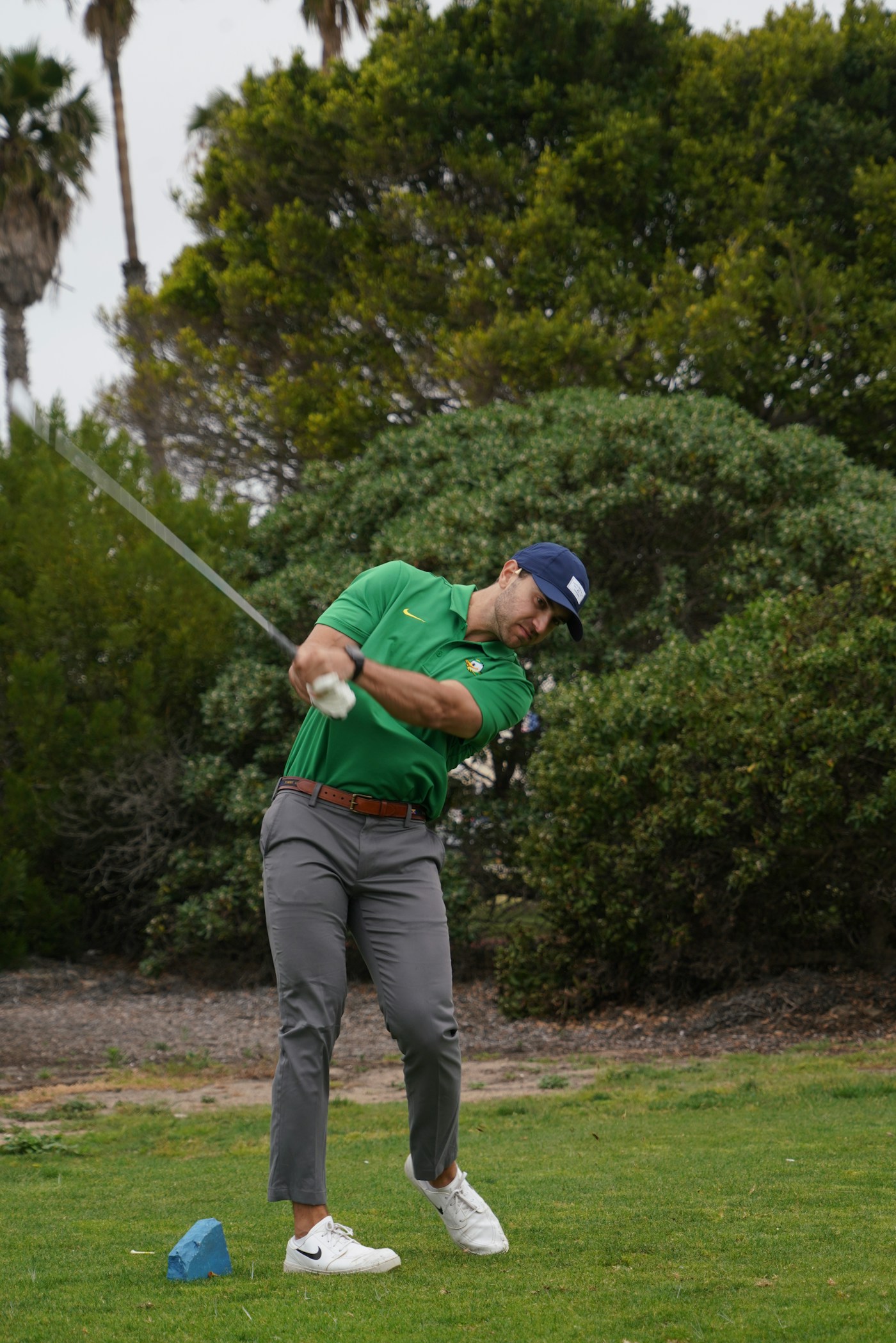
Do not turn this into a chop shot.
You still want speed through the strike. You just do not want useless height.
The Flight Window I Want
On a normal stock wedge, the ball climbs, hangs, then falls more steeply.
On a knockdown wedge, I want:
- a lower initial launch
- a flatter middle section
- and a finish that still lands with enough spin to stay useful
Think:
- boring
- flat
- predictable
That is the entire aesthetic.
If it looks sexy, you probably overdid it.
When to Use It
The knockdown wedge is my default when:
- the wind is into me
- the green is exposed
- the front carry matters
- or the stock wedge wants to launch too high for the day
It is especially useful from about 85 to 130 yards, where golfers are tempted to hit a full wedge even when the conditions are openly mocking that choice.
That is why it pairs well with wedge distance control from 90-120 yards, 60-90 yard wedge control, and 110-124 yard approach strategy. The knockdown is not separate from those systems. It is the windy-day version of them.
The Carry Rule That Saves You Fast
Here is the rule:
The knockdown shot only works if you choose a club that still carries the front safe number by at least 3 to 5 yards.
That part matters because golfers see “lower flight” and suddenly start under-clubbing like maniacs.
Example:
- front safe number is 103
- flag is 111
- wind is in
- your stock gap wedge normally carries 111
If you hit the stock gap wedge high, it may come up short. If you hit a knockdown sand wedge, it may also come up short.
The smart play is usually a flighted pitching wedge carrying about 106-108 and releasing a little.
That is how adults handle wind.
The Mistakes That Turn This Into Trash
1. Ball too far back
Then the shot turns into a low left bullet or a wipey block depending on your habits.
You are flighting it down, not trying to hit a punch under a picnic table.
2. Trying to trap it with violence
A knockdown wedge is still a wedge.
You do not need to murder it. You need a shorter motion with a committed finish.
3. Picking the wrong target
Into the wind, golfers get obsessed with the pin and forget the correct landing window.
Aim at the safe middle section more often than your ego wants.
4. Slowing down because the breeze looks scary
That is how you hit the worst possible version:
- low spin
- short carry
- no conviction
If you want less distance, take more club and make a shorter swing. Do not decelerate and beg for mercy.
My Basic Knockdown Matrix
This is a solid starting pattern for a mid-handicap golfer:
| Shot | Stock Carry | Windy-Day Version |
|---|---|---|
| 58° / 56° full-ish | 88-100 | 52° / 54° three-quarter |
| 52° / 50° stock | 100-112 | pitching wedge three-quarter |
| pitching wedge stock | 113-125 | 9-iron three-quarter when front carry allows |
Again, your numbers are yours.
The point is the pattern:
- more club
- shorter motion
- lower finish
The 12-Ball Wind Ladder
You do not need a hurricane to practice this.
Use range targets and build the flight on purpose.
Pick four carries:
- 92
- 101
- 110
- 118
Hit three balls to each with your knockdown setup.
Scoring:
- one point if carry finishes within 4 yards
- one point if the flight stays in your intended low-mid window
- zero points if it balloons or comes up obviously short
Maximum score: 24
Benchmarks:
- 18+ means you have a usable knockdown
- 14-17 means it exists but gets loose
- 13 or worse means your stock wedge is still running the show
The Towel-Finish Drill
This one cleans up the shape fast.
Put a towel or headcover under both armpits at address.
Then hit nine knockdown wedges trying to:
- keep the chest moving
- keep the arms connected
- finish no higher than shoulder height
If the towel goes flying and the club finishes around your ears, you are back in full-swing launch mode.
The On-Course Checkpoints I Want
For your next windy round, track every knockdown wedge and write down:
- yardage
- club
- front safe number
- finish result
The checkpoints:
- zero misses short of the front safe number
- at least half of them finishing pin-high or slightly past
- no more than one obvious balloon ball all round
If you keep missing short, you are not hitting a knockdown problem. You are hitting a club-selection problem.
What I Aim At in Wind
When the breeze is in and the pin is tempting, I aim:
- middle green on front pins
- hole-high center on middle pins
- and the front half of the back section on back pins
Because into-the-wind wedges punish greed.
You do not need to stuff every one. You need to stop turning manageable birdie looks into scrambling pars because you chose the prettiest possible trajectory.
Bottom Line
The best knockdown wedge is not some mystical tour-only shot.
It is just:
- one more club
- one shorter swing
- one lower finish
- and one safer carry number
Build that pattern and windy scoring-club shots stop feeling like a coin flip.
Which is good, because there are already enough ways to make bogey in this stupid game without letting a wedge balloon do it for you.
Image: Birdie Report
Related Articles