Best Golf Cart Bags 2026: Pick for Your Cart, Not Your Ego
Our top 3 picks
We may earn a commission from these links, at no cost to you. Disclosure
- Check Amazon
More separate pockets
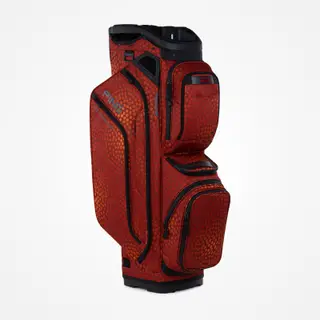
PING Pioneer
- Check Amazon
Full-length dividers
Sun Mountain C-Series C-130
Its listed capacity is 43.7 liters.
- Check Amazon
Lower price, easier lifting
Titleist Cart 14
Compare at a glance
PING Pioneer
Best for: More separate pockets
Published empty weight: 8 lb
Dividers: 15-way top; enlarged putter well
Check Amazon Read reviewSun Mountain C-Series C-130
Best for: Full-length dividers
Published empty weight: 7.6 lb
Dividers: 14 full-length dividers
Check Amazon Read reviewTitleist Cart 14
Best for: Lower price, easier lifting
Published empty weight: 5.6 lb
Dividers: 14 full-length dividers
Check Amazon Read reviewCallaway Quantum ORG 14
Best for: Front-pocket access
Published empty weight: Not listed
Dividers: 14 full-length dividers
Check Amazon Read reviewTaylorMade Cart Lite
Best for: Riding and pushing
Published empty weight: Conflicting figures*
Dividers: 14-way top
Check Amazon Read review| Pick | Best for | Published empty weight | Dividers | Retailer |
|---|---|---|---|---|
| PING Pioneer Read review | More separate pockets | 8 lb | 15-way top; enlarged putter well | Check Amazon |
| Sun Mountain C-Series C-130 Read review | Full-length dividers | 7.6 lb | 14 full-length dividers | Check Amazon |
| Titleist Cart 14 Read review | Lower price, easier lifting | 5.6 lb | 14 full-length dividers | Check Amazon |
| Callaway Quantum ORG 14 Read review | Front-pocket access | Not listed | 14 full-length dividers | Check Amazon |
| TaylorMade Cart Lite Read review | Riding and pushing | Conflicting figures* | 14-way top | Check Amazon |
Scores in this guide
PING Pioneer
9.3/10
Pros
- Sixteen pockets and 35 liters of storage is a ridiculous amount of room in a good way
- 15-way redesigned top includes a larger putter well for modern oversized putters
- Cart-strap channel and magnetic pocket support access while riding
- Strong fit for golfers who carry layers, gadgets, snacks, and too many backup balls
Cons
- Eight-pound bag weight is not pretending to be light
- You are paying premium-cart-bag money
- Storage-first design can feel like overkill for minimalist riders
- Bigger overall profile is less appealing if trunk space matters
Sun Mountain C-130
9.2/10
Pros
- Still one of the cleanest true cart-bag designs in golf
- Eleven pockets and 43.7 liters of capacity swallow basically everything
- Smart Strap System is designed to secure the bag while preserving pocket access
- 14 full-length dividers and zip-off ball pockets are useful organization features
Cons
- Cart-first design is bulky if you ever try to repurpose it
- At 7.6 pounds it is not for golfers pretending a cart bag is also a carry bag
- Style is more practical than slick
- Price is close enough to PING that preference matters more than savings
Titleist Cart 14
9/10
Pros
- Strong price relative to the rest of this premium cart-bag field
- 5.6-pound build is notably easier to move around than the storage monsters
- Symmetrical layout and 10 cart-accessible pockets keep it simple
- Fourteen full-length dividers provide individual club organization
Cons
- Storage ceiling is lower than PING or Sun Mountain
- Less of a feature flex if you love gadget pockets
- Single-strap, simpler design feels more straightforward than luxurious
- Not the obvious pick for gear-heavy riders
Callaway Quantum ORG 14
8.9/10
Pros
- Front-facing GPS pocket and rapid-access layout prioritize convenient access
- LOWRIDER compatibility and oversized cooler-lined pocket are smart riding features
- 14-Way Shaft Shield top gives it a more modern protection-first identity
- Cleaner middle ground between storage and convenience than some bulkier bags
Cons
- Ten-pocket layout is solid but not class-leading
- Does not undercut the category on price
- Less iconic track record than the C-130 in this exact niche
- Value case depends on how much you care about the Callaway-specific feature set
TaylorMade Cart Lite
8.7/10
Pros
- TaylorMade positions it as the lightweight option, and the design clearly leans that way
- Pushcart-enabled base makes it more flexible than pure riding-cart tanks
- Eleven pockets and a large integrated cooler keep it useful without going full cargo-ship
- Good fit for golfers who split time between riding and push-cart walking
Cons
- Not the most feature-rich option in the field
- Storage argument is weaker than PING or Sun Mountain
- Price is high enough that a stronger specialty case would help
- Less compelling if you know you are a full-time riding-cart golfer
Compare five golf cart bags by dividers, empty weight, pockets, and cart fit. Research-based 2026 picks, with a checklist before the bag sits crooked.
If you ride most rounds, a cart bag can make club organization and pocket access simpler. Sixteen pockets will not rescue a bag that sits crooked on your push cart or traps your putter grip. Buy for the cart and clubs you actually use.
Your slice has survived nicer purchases than this. So has the cart-path temper. The bag’s job is smaller and less glamorous: hold the clubs, sit where the cart expects it, and let you reach a sleeve without a scene.
The Cart 14 and Cart Lite are the bag gifts with verified Amazon pages. The 2026 golf gift guide repeats those links and the prices from this guide. A cart bag does not fit a sock. That list is the 2026 golf stocking stuffers guide. If you are shopping the sale weekend by club, start with the Black Friday golf deals hub, then come back here for the fit check.
My shortlist: PING Pioneer for compartment-heavy riding storage; Sun Mountain C-Series C-130 for its large listed capacity; Titleist Cart 14 for the lower listed price; Callaway Quantum ORG 14 for front-pocket access; TaylorMade Cart Lite for a push-cart-oriented design.
This is a research-based buying guide, checked against the manufacturer pages linked below on September 28, 2026. The recommendations and comparison scores are editorial judgments about published features, not measured test results. I have not established hands-on testing of these bags. Prices below are manufacturer reference prices, not promises of Amazon pricing or stock. The November 18 update is the writing. It is not a new measurement.
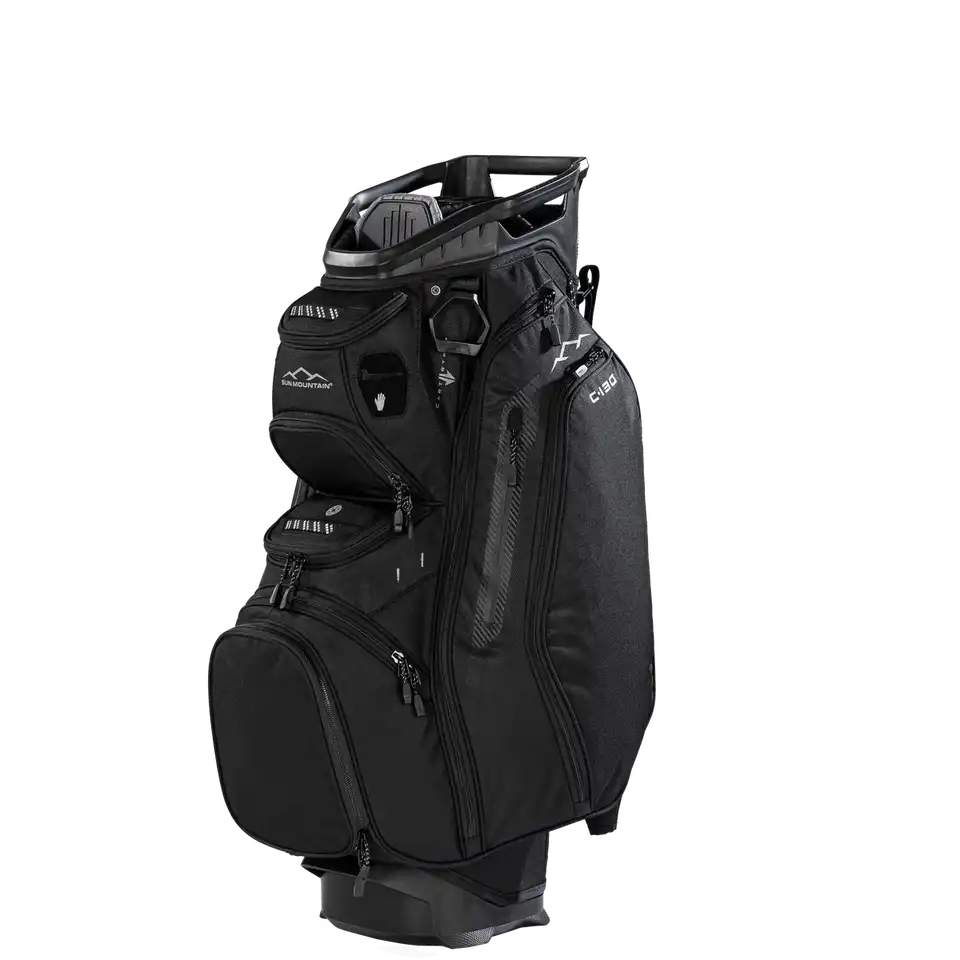
Image courtesy of Sun Mountain. Product image, not an owner testing photo.
Start With These Three Buying Questions
- Will you ride, push, or carry? A bag designed around a cart is a different purchase from a bag you plan to carry for eighteen holes. If carrying is part of the plan, start with our walking-bag guide. For a broader comparison, use Best Golf Bags 2026. Strapping a stand bag to a riding cart and calling it fine is how you spend the round fishing for a sleeve while the group watches.
- Does your exact club set fit? A 14-way top describes the openings at the top. It does not, by itself, establish fourteen separate full-length channels. Check the divider specification and try your largest grips. A larger putter opening is useful only if your putter can enter and leave it comfortably. The product photo will not shrink your grips.
- Can you reach your gear when the bag is secured? Check the strap route and open the pockets with the bag attached. A wonderful cooler pocket becomes less wonderful when you have to unbuckle the bag to reach lunch. That is a zipper fight with an audience.
Verified Specs: What the Numbers Actually Tell You
On smaller screens, scroll the table sideways to compare all five columns. Empty weight, dividers, and pocket count are the argument. The heaviest bag is not a personality.
| Bag | Manufacturer price | Published empty weight | Divider information | Pockets |
|---|---|---|---|---|
| PING Pioneer | $330 | 8 lb | 15-way top; enlarged putter well | 16 |
| Sun Mountain C-Series C-130 | $325 | 7.6 lb | 14 full-length dividers | 11 |
| Titleist Cart 14 | $245 | 5.6 lb | 14 full-length dividers | 10 |
| Callaway Quantum ORG 14 | $299.99 | Not stated on cited page | 14 full-length dividers | 10 |
| TaylorMade Cart Lite | $299.99 | Conflicting figures* | 14-way top | 11 |
TaylorMade’s linked page says 5 pounds in its description and 5.5 pounds in its comparison chart. I am leaving that conflict visible rather than choosing a number. Confirm the exact SKU with TaylorMade if lifting weight decides your purchase. Likewise, do not assume every model with “C-130” or “ORG 14” in its name has the specifications in this table.
The Titleist is 2.4 pounds lighter empty than the PING using their published figures. That matters when lifting a loaded bag into a trunk, even if a cart carries it around the course. These are manufacturer figures, not weights measured here. Two-point-four pounds sounds like a rounding error until you are the one heaving the loaded bag over a bumper.
PING Pioneer: For Riders Who Want More Separate Pockets
The PING Pioneer product page lists 35 liters of pocket volume, a cart-strap channel, magnetic pocket and trunk handle. Its redesigned top includes an enlarged putter well. Those features make it my storage-organization pick for riders who pack layers, a rangefinder and plenty of extras. If your cart already looks like a junk drawer that learned to ride, at least give the junk a pocket.
Skip it if: low lifting weight matters more than compartment count. Also, PING explicitly describes the insulated pocket as not waterproof. Insulation is not a promise that loose ice or leaking bottles will stay contained. A damp glove is annoying. A soaked rangefinder is a worse afternoon.
PING’s cited specification says 15-way top; it does not establish fifteen individual full-length dividers. Confirm that detail before purchasing if complete club separation is your deal-breaker. Openings at the top and full-length channels are different promises. Buy the one the page actually makes.
Check PING Pioneer listings on Amazon. For the closest storage comparison, read PING Pioneer vs Sun Mountain C-130.
Sun Mountain C-Series C-130: For Storage With Full-Length Dividers
The C-Series C-130 page specifies a 9-inch top, individual dividers extending the length of the bag, the Smart Strap System and zip-off ball pockets. Its listed capacity is 43.7 liters.
That is the largest stated capacity among the three bags here whose cited pages give liters. It is not a measured packing-space win: Sun Mountain calls its number capacity, while PING calls its number pocket volume. Those descriptions do not establish a shared measurement method. Do not turn the parking lot into a debate about which number is “bigger.” They are not the same kind of number.
Skip it if: you want a lighter bag for frequent lifting or have very little trunk room. At 7.6 pounds empty, this is a storage-first choice. Confirm the listing says C-Series C-130 and matches this divider/pocket arrangement; similar names are not enough. A listing that merely says C-130 is how you buy a different bag and then blame the game.
Check Sun Mountain C-130 listings on Amazon. Compare the tradeoff with C-130 vs Titleist Cart 14.
Titleist Cart 14: For a Lower Price and Easier Lifting
The Titleist Cart 14 page specifies a symmetrical layout, single strap, strap loop and large beverage pocket. Its published 10-inch base width is useful information to bring to a fit check, not a guarantee that it suits every cart cradle.
Full-length dividers, a lighter published empty weight than the Pioneer, and a 10-inch base you can check against the cart cradle. That is the case for it if you want the clubs separated and do not need sixteen pockets. The balls you are going to donate to the water do not need a junk drawer to get there.
Skip it if: your must-have features include PING’s magnetic-pocket arrangement or Callaway’s front-facing GPS pocket. Compare the actual pocket layout before paying for extra features you may never use. A pocket you never open is just a zipper you will cuss at.
Check the Titleist Cart 14 on Amazon (Washed Indigo / Blue Bird / White; other current colors are on that listing), or use PING Pioneer vs Titleist Cart 14 for the price-versus-storage decision.
Callaway Quantum ORG 14: For Front-Pocket Access
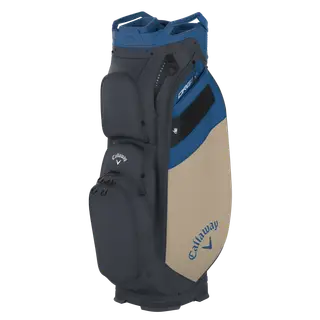
The Quantum ORG 14 product page lists a Shaft Shield top, LOWRIDER compatibility, a front-facing GPS pocket, rapid-access pocket and cooler-lined pocket. Callaway gives its capacity as 33 liters and dimensions as 36 inches high by 10 wide by 16 deep.
This is my convenience-layout pick if the gear you retrieve repeatedly matters more than maximizing pocket count. LOWRIDER compatibility is a manufacturer feature claim; it is not proof that this bag fits your particular push cart. The rangefinder cares whether you can grab it while the cart is already rolling. It does not care about the logo.
Skip it if: you are paying extra mainly for a feature you will not use. The Titleist’s lower reference price is a good reason to stop and compare. Do not substitute specifications from an older ORG 14 or an ORG 14 HD listing for this Quantum model. Similar names are a good way to buy the wrong bag.
Check Quantum ORG 14 listings on Amazon, or compare Callaway Quantum ORG 14 vs Titleist Cart 14.
TaylorMade Cart Lite: For Golfers Who Alternate Riding and Pushing
The TaylorMade Cart Lite Golf Bag page describes a base designed for push and riding carts, a strap pass-through and an integrated cooler. That makes it a sensible candidate for mixed cart use, subject to a fit check. The name leans light. The page also disagrees with itself on the empty weight, which is why the table leaves that conflict visible.
Skip it if: you want to carry your clubs regularly. “Lite” is not a substitute for a carry-bag harness and stand. Also, confirm the exact model, color and availability with the seller; product-page variants can show different shipping states.
Check the TaylorMade Cart Lite on Amazon (2025 Coral; other colors are on that listing). If front-pocket convenience is the competing priority, use TaylorMade Cart Lite vs Callaway Quantum ORG 14.
Before Buying: A Practical Cart-Fit Checklist
Take these checks to a retailer or use them within the seller’s return terms. They are buying checks, not tests I have performed on these five bags.
- Seat the base first. It should rest securely in your cart’s lower support without perching on an edge. Check the upper support too; do not judge fit only by top width. A bag that looks proud of itself and is actually perched on one edge will annoy you by the third hole.
- Route and tighten the straps. Use the intended channels or attachment system. Open the valuables, ball, rangefinder and beverage pockets while secured. Check that the strap does not crush a zipper or handle.
- Load your real clubs. Try the largest iron grip and putter grip. Remove and replace them with neighboring clubs in place. A divider count cannot answer whether your particular setup snags.
- Check clearance on a push cart. With the cart stationary and secured, check access to its brake and folding controls and clearance around the wheels. Follow the cart manufacturer’s bag-mounting instructions. See our push-cart guide if you are choosing both pieces together.
- Try the lift and trunk fit. Consider the loaded weight and where your hands can grip it. A bag you dread lifting twice a round is the wrong bag, however impressive its pocket count looks. That is a pain in the ass with a logo on it.
- Match the seller listing. Check model name, divider construction, color, included rain hood, returns and final price. The Titleist link opens the verified Cart 14 page (Washed Indigo / Blue Bird / White). The TaylorMade link opens the verified 2025 Coral Cart Lite page. Other colors are on those listings. The other Amazon links open searches, so those results may include older models, unrelated accessories, or different sellers.
Which One Would I Choose?
For a rider who wants lots of separate storage, start with the Pioneer. For full-length dividers and a large published capacity, compare the C-Series C-130. For lower price and less empty weight, the Cart 14 is the straightforward starting point.
Choose between Quantum ORG 14 and Cart Lite by pocket access, divider layout, and how the base sits on your cart. A name on the side will not tell you whether the rangefinder pocket faces you or whether the strap crushes a zipper. The best bag here is the one that holds your clubs, mounts properly and lets you reach your stuff without a wrestling match. It will not fix the slice. It can stop the zipper fight.
Frequently asked questions
Does a cart bag fix a bad round?
No. If you ride, it can make club organization and pocket access simpler. It does not fix a slice, a temper, or the habit of buying another driver. Buy for the cart and the clubs you actually use.
Which of these is easier to lift?
Using the published empty weights, the Titleist is 2.4 pounds lighter than the PING. TaylorMade’s linked page says 5 pounds in its description and 5.5 pounds in its comparison chart, so that conflict stays in the table. Callaway’s cited page does not state an empty weight. These are manufacturer figures, not weights measured here.
Which bags have a verified Amazon page?
The Cart 14 and the Cart Lite. Those are the bag gifts with verified Amazon pages. The Pioneer, C-130, and Quantum ORG 14 links on this page open searches, so confirm the model before you buy. The 2026 golf gift guide repeats those verified links.
What should I check before I buy?
Seat the base, route the straps, and open the pockets while the bag is secured. Load your real clubs, including the largest grips and the putter. A divider count cannot tell you whether your setup snags. The checklist above is a buying check. It is not a test I have performed on these five bags.
Where to Buy
Current retailer options
Affiliate links may earn us a commission. A direct link opens one verified Amazon product page. A search link opens results. Confirm the model, seller, and current price.
PING Pioneer Cart Bag
Best for: Sixteen pockets and 35 liters of storage is a ridiculous amount of room in a good way
Sun Mountain C-130 Cart Bag
Best for: Still one of the cleanest true cart-bag designs in golf
Titleist Cart 14 Bag (Washed Indigo)
Callaway Quantum ORG 14 Cart Bag
Best for: Front-facing GPS pocket and rapid-access layout prioritize convenient access
TaylorMade Cart Lite Golf Bag (2025 Coral)
Related Articles